LDS Temple ExplainedFree PDF

A plain-language guide

The LDS temple endowment, explained

What happens inside a temple of The Church of Jesus Christ of Latter-day Saints, from the recommend interview to the celestial room: on one free chart, and step by step in plain words.

For anyone going for the first time, family and friends who wait outside, former members, researchers and the curious. Every fact links to its source.

Download the free chart

PDF, 52 × 52 in, 3.6 MB · or a 7,488 px JPG · Public domain (CC0)

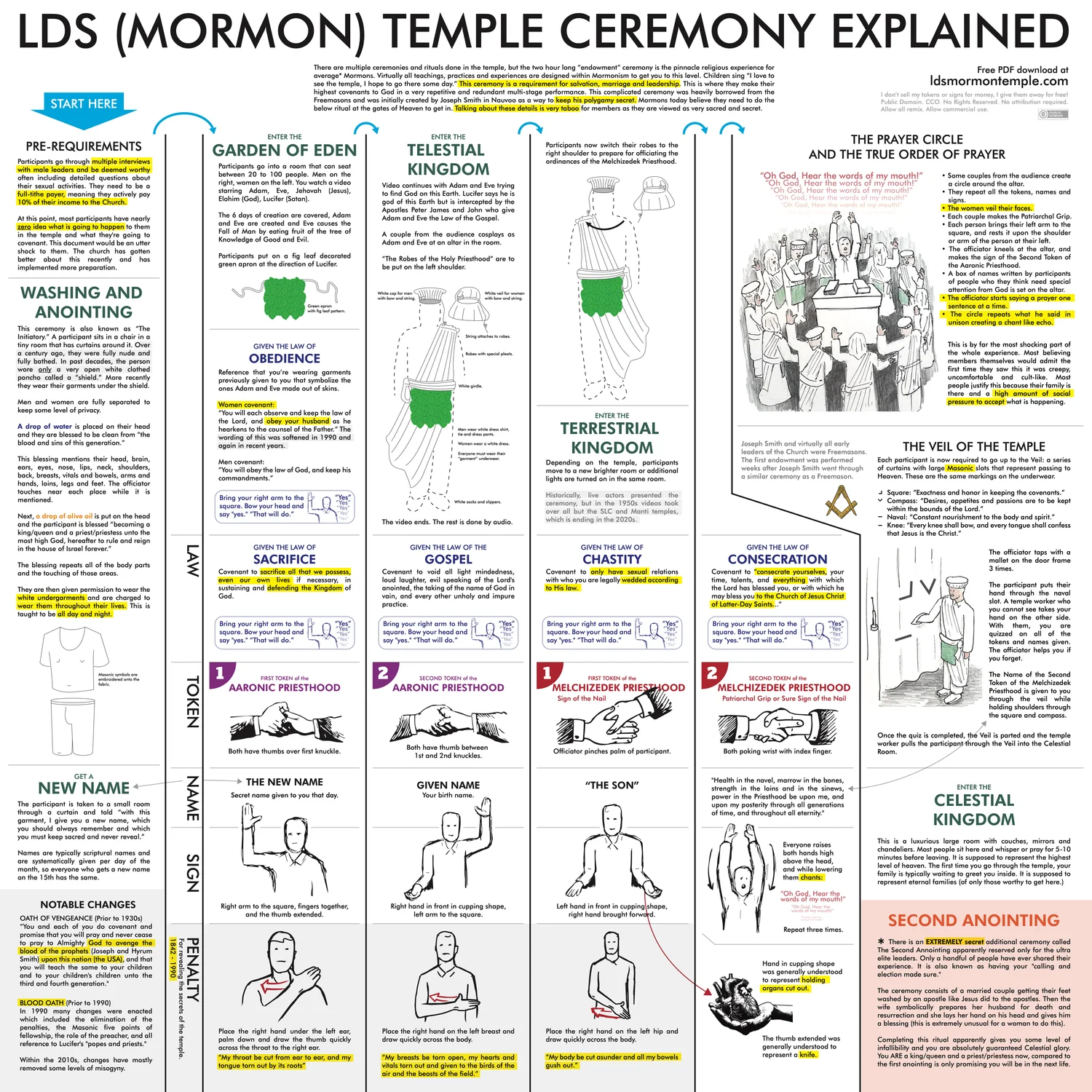
The chart “LDS (Mormon) Temple Ceremony Explained”: the requirements and the initiatory down the left side; across the top, the endowment from the Garden of Eden through the telestial and terrestrial worlds to the prayer circle, the veil and the celestial room; below, the five covenants, four tokens with their names and signs, and the penalties removed in 1990; and the second anointing in the corner.
Click any part of the chart to zoom in and read about it.Tap any part of the chart to zoom in and read about it.
  1. Start here

    Top left: what comes before, then the private initiatory (washing, anointing, the garment and a new name).

  2. Follow the arrows

    Across the top, the endowment as a journey: the Garden of Eden, the world, the terrestrial world, the prayer circle, the veil and the celestial room.

  3. Read down the columns

    Under each stage, what is learned there: a law (covenant), a token, its name and its sign. The gray row shows the penalties, removed in 1990.

The ceremony, step by step

From the recommend to the celestial room

The whole sequence in order, in plain words, with the matching part of the chart. Small numbers link to the sources for each paragraph. Where today’s ceremony differs from what the chart shows, a “Then and now” note says how.

Before the temple

The recommend, preparation and arriving.

Before you go

A temple recommend

A dedicated temple is open only to members of the Church who hold a current temple recommend: a small card, shown at the front desk, that says the member has been interviewed and found ready.12

Before their own endowment, a member is interviewed by their bishop and then their stake president. The questions are published in the Church’s General Handbook. They ask about faith in God and Jesus Christ, support for Church leaders, the law of chastity, honesty, family life, the Word of Wisdom and tithing: “Are you a full-tithe payer?”, meaning a tenth of one’s income.23

Members are usually endowed when they are at least 18, finished with high school and a year past their confirmation, or when they are preparing for a mission or a temple marriage. Younger members, from the year they turn 12, can hold a recommend to do baptisms for the dead, but they are not endowed.45

Most congregations offer a temple preparation class. The Church’s course and booklet explain what the covenants are for, but not what is said and done in the ceremony, which members are asked not to discuss outside the temple.674

Before you go

Arriving

Wear what you would wear to church on Sunday. When you book your first endowment, the temple sends instructions, including what clothing to bring or rent.1

A worker at the front desk checks your recommend. In the locker room, where each person has a private dressing space, you change into white clothing. You will need your own temple garments, bought beforehand; the ceremonial clothing can be bought, or rented at some temples.2345

You may bring an endowed friend or relative of the same gender as your escort, and the temple can provide one. Of the endowment, the Church says: “It isn’t a test.”16

The initiatory

Private ordinances, given once before the first endowment.

The initiatory

Washing and anointing

Before the first endowment, each person receives the initiatory ordinances “privately and individually,” from a temple worker of the same gender. The Church describes them as a symbolic washing and anointing, plus instruction on wearing the temple garment.12

A little water, then a little olive oil, is applied to the head. With hands on the person’s head, the worker pronounces blessings on each part of the body in turn. The Church’s booklet calls these ordinances “mostly symbolic in nature,” with promises of blessings now and in the future.345

This part has changed more than any other. In Nauvoo in the 1840s, people were washed in a tub and anointed with oil poured from a horn. Later the washing became symbolic, and people wore a “shield,” a white poncho-like covering. Since January 2005 they put on the garment first, wear a shield closed at the sides over it, and only the head is touched.564

The initiatory

The garment

The initiatory ends with the person being clothed in the temple garment: white underclothing in two pieces, a top and a bottom, worn under everyday clothes.12

In the Church’s words, the garment “reminds us of the veil in the temple, and that veil is symbolic of Jesus Christ.” Endowed members wear it day and night for the rest of their lives, and don’t alter it to suit fashions.34

It carries four small marks, sewn or printed, that match marks on the veil at the end of the endowment. Two of them, a square and a compass, were adapted from Freemasonry.56

The design changes from time to time. The original ankle-and-wrist garment was shortened in 1923, and since 2024 redesigned garments, including sleeveless options, have rolled out worldwide.78910

The initiatory

A new name

During the initiatory, each person is given a new name, a key word used later in the endowment. Members keep it to themselves, except that a wife’s new name is made known to her husband.1

Latter-day Saint scripture speaks of a new name, written on a white stone, given to those who enter the celestial kingdom (Doctrine and Covenants 130:11). Beyond that, the Church’s published material says little about it.2

Sources

  1. Endowment (Mormonism)Wikipedia
  2. Doctrine and Covenants 130Church of Jesus Christ

The endowment

A group ceremony: a story, five covenants, and the veil.

The endowment

The instruction room

The endowment itself is given to a group, seated in an instruction room. Some of it is a film and some is led by temple workers.1

Since 2023 the session begins by naming the five covenants participants will make. Reporters put the session at 90 to 105 minutes in 2023, and close to an hour after more was trimmed in 2024. In the 1840s it took “the better part of a day.”234

Film was first used in 1955, at the new temple in Switzerland, so the endowment could be given in several languages. Before that, temple workers acted the parts live, and people moved from room to room. The Salt Lake and Manti temples were the last to use live actors; in 2021 the Church announced both would use film after their renovations.45678

The endowment

The creation and the Garden of Eden

The presentation is a story. The Church summarizes its subjects as the Creation, the Fall of Adam and Eve, the Atonement of Jesus Christ, the Apostasy and the Restoration.1

Its characters include Elohim (God the Father), Jehovah (Jesus Christ before his birth), Michael, who becomes Adam, and Eve, along with Lucifer, who tempts them. Since 2023 it also shows the War in Heaven. Adam and Eve eat the fruit and must leave the garden.234

Part of the ceremonial clothing is a green apron, a reminder of the fig leaves Adam and Eve sewed together in Genesis. The chart shows it put on here, in the garden.52

The chart places the first two covenants, obedience and sacrifice, in the garden. Since January 2019, men and women make the same covenants, each directly with God.6

The endowment

The lone and dreary world

Adam and Eve enter the “lone and dreary world,” the world of ordinary life, which the ceremony calls the telestial world. There they seek further light, and Peter, James and John appear as messengers sent to teach them.123

Over their white clothes, participants wear ceremonial clothing: a robe over one shoulder, a sash, the green apron, and a cap for men or a veil for women. Everything is white except the apron. The chart shows the pieces put on in stages as the story goes; since 2023, participants stay seated for most of the session and no longer stop to adjust their clothing.4563

The clothing was redesigned in 2020 to be “more simple, comfortable, and cost-effective.” The chart places the law of the gospel in this part of the story.7

The endowment

The five covenants

The heart of the endowment is five covenants, or promises to God. The Church names them openly; the exact words are among the things members don’t repeat outside the temple.12

Participants make them together, one at a time, as the story reaches each one. Everyone makes the same five.34

  1. First

    The law of obedience

    To try to keep God’s commandments.

    The Church’s words: “striving to keep Heavenly Father’s commandments”1

  2. Second

    The law of sacrifice

    To give up what it takes to support the Lord’s work, and to repent.

    The Church’s words: “sacrificing to support the Lord’s work and repenting with a broken heart and contrite spirit”1

  3. Third

    The law of the gospel

    To have faith in Jesus Christ, keep one’s covenants and keep going to the end of life.

    The Church’s words: “exercising faith in Jesus Christ, making and honoring essential covenants with God, enduring to the end”1

    Until 2023 this covenant also asked participants to avoid “loud laughter,” among other things; that phrase was dropped.3

  4. Fourth

    The law of chastity

    No sexual relations outside a legal marriage between a man and a woman.

    The Church’s words: “abstaining from sexual relations outside of a legal marriage between a man and a woman”1

  5. Fifth

    The law of consecration

    To give one’s time, talents and everything one has to building up the Church.

    The Church’s words: “dedicating our time, talents, and everything with which the Lord has blessed us to building up Jesus Christ’s Church”1

The endowment

Signs, tokens and names

With the covenants, participants learn four tokens: two “of the Aaronic Priesthood” and two “of the Melchizedek Priesthood.” A token is a particular handclasp. Each has a name (a word or phrase) and a sign (a gesture). The chart draws all four.12

The Church quotes Brigham Young: the endowment gives “the key words, the signs and tokens” needed to walk back to God past the angels “who stand as sentinels.” These are the things members promise not to reveal.23

Historians note that the tokens, signs and penalties closely resemble Masonic ritual, while the story, the covenants and the washings have no Masonic parallel. The Church acknowledges “similarities between some elements” of the two.45

Since 2023, participants no longer practice the tokens with each other’s hands during the session; the first touch comes at the veil.6

The endowment, 1842–1990

The penalties

Until 1990, three of the tokens came with a penalty: a gesture miming a violent death, and words agreeing to suffer it rather than reveal the token. They closely followed the oaths of Masonic ritual.12

The spoken words were softened in the 1920s, and in April 1990 the Church removed the penalties completely, words and gestures. The chart shades them gray and dates them 1842–1990 for that reason.13

The endowment

The terrestrial world

The story moves up to the “terrestrial” world, a higher, brighter stage. In most temples built since 2002 this part has its own room. On the chart, participants move the robe from the left shoulder to the right at this point.12

The chart places the laws of chastity and consecration here, the last two covenants.

Sources

  1. Endowment (Mormonism)Wikipedia
  2. Ordinance roomWikipedia

The endowment

The prayer circle

Near the end, some participants are invited to stand in a circle around an altar, in their ceremonial clothing. Joseph Smith called this “the true order of prayer.”12

The circle makes the signs learned earlier. Then one person at the altar offers a prayer a phrase at a time, and the circle repeats each phrase. The names on the temple’s prayer roll, people members have asked to be prayed for, are included; since 2020 names can be sent in online.123

Since 1978, prayer circles happen only in temples, as part of the endowment.1

The endowment

The veil

The session ends at the veil, a white curtain across the room; the chart notes it bears the same marks as the garment. On the other side is the celestial room.1

One at a time, participants come to the veil. A temple worker behind it represents the Lord. The participant gives the tokens and names learned in the session, with a worker beside them to help, and is then brought through. The Church describes this as symbolically returning “to the Lord’s presence.”123

Until 1990 this included an embrace at the veil called the “five points of fellowship.”45

The endowment

The celestial room

The celestial room stands for heaven. No ceremonies happen there; the Church calls it “a place of quiet peace, prayer, and reflection.”12

Family and friends who came to the session often sit with someone here after their first endowment, before everyone changes back into their own clothes.3

Sources

  1. Inside TemplesChurch of Jesus Christ
  2. About the Temple EndowmentChurch of Jesus Christ
  3. “Preparing for Your Endowment,” For the Strength of YouthChurch of Jesus Christ, Oct 2021

Beyond the endowment

Sealings, ordinances for the dead, and a rare second anointing.

After the endowment

Sealings

Endowed members can marry in the temple, which the Church calls being sealed. It teaches that a sealing joins husband and wife “for time and all eternity.” Children can be sealed to their parents as well.1

Since May 2019, couples married outside the temple no longer wait a year to be sealed. Since October 2019, endowed women can serve as witnesses to sealings. Since 2021, temples no longer perform marriages “for time only.”234

After the endowment

Ordinances for the dead

After their own endowment, members come back to the temple to receive the same ordinances on behalf of people who have died. Acting as proxies, they are baptized and confirmed, receive the endowment and take part in sealings for ancestors and others.12

A proxy endowment is the same session described above, attended in someone else’s name.1

Sources

  1. Temples (Topics and Questions)Church of Jesus Christ
  2. Why Ordinances and Covenants MatterChurch of Jesus Christ

Rarely

The second anointing

The Church doesn’t discuss this ordinance publicly, so what follows comes from historians. Today it is given privately to a small number of married couples chosen by the Church’s top leaders. Church leaders have described it as having one’s “calling and election made sure.”12

In historians’ accounts, an officiator washes the husband’s feet, then anoints him a king and priest and his wife a queen and priestess. Later, in private, the wife washes and anoints her husband’s feet and gives him a blessing.12

It was given regularly from the 1840s to the 1920s (about 15,000 times for living people by 1941) and has been far rarer since the 1920s.12

History

How it has changed

The Church says of its temple ceremonies that “there will be no end to such adjustments,” but it rarely lists them. Most of the details below come from historians and news reporting, and each entry says where.

1842

Where the ceremony came from

Joseph Smith first gave the endowment on May 4, 1842, to nine men in the upper room of his Red Brick Store in Nauvoo, Illinois.123

Seven weeks earlier, on March 15 and 16, he had become a Freemason, and all nine men were Masons. The Church acknowledges “similarities between some elements” of the two rituals, and says the endowment “did not simply imitate” Masonry: Joseph’s encounter with it “evidently served as a catalyst for revelation.” Historians such as David Buerger find the signs, tokens and penalties closely parallel Masonic ritual, while the creation story, the covenants and the washings do not.456

The endowment and plural marriage took shape in the same years, among many of the same trusted people; several of Joseph’s plural wives were in the group that received the early endowment. Some argue, as the chart does, that the ceremony was created to keep plural marriage secret. Buerger found no evidence that Joseph taught plural marriage in that group, and FAIR, a Latter-day Saint apologetics group, rejects the idea.768

  1. May 4, 1842

    The first endowment

    Joseph Smith gives the endowment to nine men in the upper room of the Red Brick Store in Nauvoo, seven weeks after becoming a Freemason.

  2. 1845–1846

    The Nauvoo Temple

    Before the Saints leave Nauvoo for the West, thousands receive the endowment in the temple’s attic: more than 6,000 by early February 1846, by the Church’s count (Buerger estimates about 5,200).

  3. 1877

    Written down at St. George

    When the St. George Utah Temple opens, Brigham Young has the ceremony written out so it can be given the same way everywhere.

  4. 1904–1906

    The oath of vengeance in the Senate

    At the Senate hearings over seating Apostle Reed Smoot, witnesses describe a prayer in the ceremony asking God to avenge the deaths of Joseph and Hyrum Smith on the nation.

  5. 1919–1927

    A committee revises the ceremony

    A committee of apostles, led from 1921 by George F. Richards, writes down and trims the ceremony. The spoken penalties are softened (the gestures stay), and in 1927 a letter to every temple president removes the oath of vengeance.

  6. 1923

    A shorter garment

    A garment with sleeves to the elbow and legs to the knee, with buttons instead of ties, is approved for everyday wear.

  7. Sept 11, 1955

    Film

    The Swiss Temple opens with the first filmed endowment, so it can be presented in several languages. Film spreads to other temples in the decades that follow.

  8. 1978

    Prayer circles move into the temple

    Prayer circles outside temples end; since then they happen only as part of the endowment.

  9. April 10, 1990

    The penalties are removed

    The penalties (words and gestures), the embrace at the veil called the five points of fellowship, and a preacher character are taken out. Women no longer vow to obey their husbands.

  10. January 2005

    The initiatory changes

    People now put on the garment before the initiatory and wear a shield, closed at the sides, over it. Water and oil are applied only to the head, and the worker’s hands stay on the head while each part of the body is blessed.

  11. Jan 2, 2019

    Women’s covenants

    Women no longer covenant to “hearken” to their husbands; men and women make the same covenants with God. Eve speaks more, women no longer veil their faces, and the session is shorter. The Church confirms changes but not the details: “there will be no end to such adjustments.”

  12. May–Oct 2019

    Sealings and witnesses

    Couples married outside the temple no longer wait a year to be sealed (May). The recommend questions are published (October), and endowed women can serve as witnesses to sealings (October).

  13. Jan 17, 2020

    Simpler temple clothing

    The ceremonial clothing is redesigned to be “more simple, comfortable, and cost-effective.”

  14. July 2020

    More adjustments

    As temples reopen during the pandemic, the First Presidency announces further, unspecified changes to the endowment.

  15. March 2021

    The last live sessions end

    The Church announces that the Salt Lake and Manti temples, the last to present the endowment with live actors, will use film after their renovations. Salt Lake’s murals are removed. In May the Church decides Manti’s will stay, and when Manti reopens in 2024 its filmed endowment still moves from room to room.

  16. February 2023

    A more Christ-centered session

    Reporters describe a reworked session: it opens by naming the five covenants; the witness couple and the passing of tokens hand to hand are gone, with Adam and Eve demonstrating on screen; participants stay seated for most of it; the War in Heaven is added; and the warning against “loud laughter” is dropped.

  17. August 2024

    Shorter again

    About 15 more minutes of repeated phrases are trimmed, bringing a session close to an hour, according to The Salt Lake Tribune. A Church spokesperson pointed to the 2020 statement asking members not to speculate about the changes.

  18. Oct 17, 2024

    Redesigned garments

    The First Presidency authorizes redesigned garments, including sleeveless options, first in hot, humid places; the rollout runs through 2025 and reaches the U.S. in October 2025.

  19. 2027

    The Salt Lake Temple reopens

    After its long renovation, the Salt Lake Temple holds a public open house from April 5 to October 1, 2027, before rededication. When it reopens, its endowment will be on film in a single room.

For first-timers

What to expect

How long does it take?

The endowment session itself runs about an hour since the 2024 changes (reporters measured 90 to 105 minutes in 2023). On your first visit, also allow time to check in, change clothes and receive the initiatory beforehand. The temple tells you when to arrive when you book.

What do I wear?

Come in the clothes you would wear to church on Sunday. Inside, you change into white clothing, with the temple garment underneath. The ceremonial robe, sash, apron and cap or veil go on over the white clothing during the session.

What is provided, and what do I bring?

Bring your recommend and the garments you bought beforehand. Temple clothing can be bought; some temples rent it, and if yours doesn’t you bring your own. Lockers and private dressing spaces are provided. The temple sends instructions when you book your first endowment.

Can someone come with me?

Yes. You may invite an endowed friend or relative of the same gender to be your escort, and the temple can provide one. Endowed family and friends can attend the session with you and sit with you in the celestial room afterward.

Can I ask questions, or leave?

The Church encourages questions before you go: “it’s OK to ask them,” and temple workers are there to help during your first session. Its published guides don’t say what to do if you need to stop partway; if you feel unwell or need a break, tell your escort or a temple worker.

Is it secret?

The Church asks members not to discuss the symbols, or “the holy information we covenant in the temple not to reveal,” outside the temple, nor the exact words used. They may talk about the purpose and doctrine of temple ordinances and how they felt. Its preparation booklet explains it this way: “not that they are secret … but because they are sacred.”

Can people who aren’t members see inside?

Not once a temple is dedicated. New and renovated temples hold public open houses beforehand; the Salt Lake Temple’s runs from April 5 to October 1, 2027. The Church has also published video and photos of the temple clothing and rooms.

About the chart

A chart by Riley Adamson

Riley Adamson drew this chart in 2024 to put the whole temple endowment on one page, in the order it happens, so that someone could know what to expect. This is edition 08, from December 2024. He makes charts that explain complicated things in a single picture.

He dedicated it to the public domain. In his words on the chart: “I don’t sell my tokens or signs for money, I give them away for free!” Anyone may copy, print, change or share it, even commercially, without asking. Since 2025 it has also been on Wikimedia Commons, where it illustrates Wikipedia’s articles on the endowment and on the penalties.

The chart and this site are one project. The chart puts the whole ceremony on one page in Riley’s own voice, including what he made of it. The site walks through each part in plain language with sources, and a “Then and now” note marks where today’s ceremony differs from what the chart shows.

Title
LDS (Mormon) Temple Ceremony Explained
Edition
08, December 2024
Size
52 × 52 inches (132 × 132 cm)

Download, print, share

Free, with no sign-up. Print the PDF full size so the smallest type stays readable; most print shops can print a large square sheet from it.

About this site

This site is a plain-language guide to the temple endowment of The Church of Jesus Christ of Latter-day Saints, written for people preparing to attend for the first time, families and friends who can’t go in, former members, researchers and anyone curious.

Every statement links to its source. We prefer the Church’s own published material, then Wikipedia, historians and major news reporting. Where the Church hasn’t described something, we say who has. The ceremony is explained in our own words; quotations are kept short and used only where the exact words matter.

This site is free and non-commercial. It is not affiliated with or endorsed by The Church of Jesus Christ of Latter-day Saints.

All sources 63

The Church 39

Wikipedia 13

Scholarship 5

News 6

The chart: LDS Temple Ceremony Explained

Loading the chart…